Sample report · Katoomba 2780, NSW
One household, the whole report.
This is a sample: a Katoomba household — an older member at home, medicine kept refrigerated, a house at the bush edge, a packed go-bag — assessed in full, exactly as a full report renders. Your own household will differ; that is the point of the questions.
Their top risk
Bushfire (incl. grassfire) — 98 of 100
Engine rank #1 for your household before point-level refinement.
Their household type
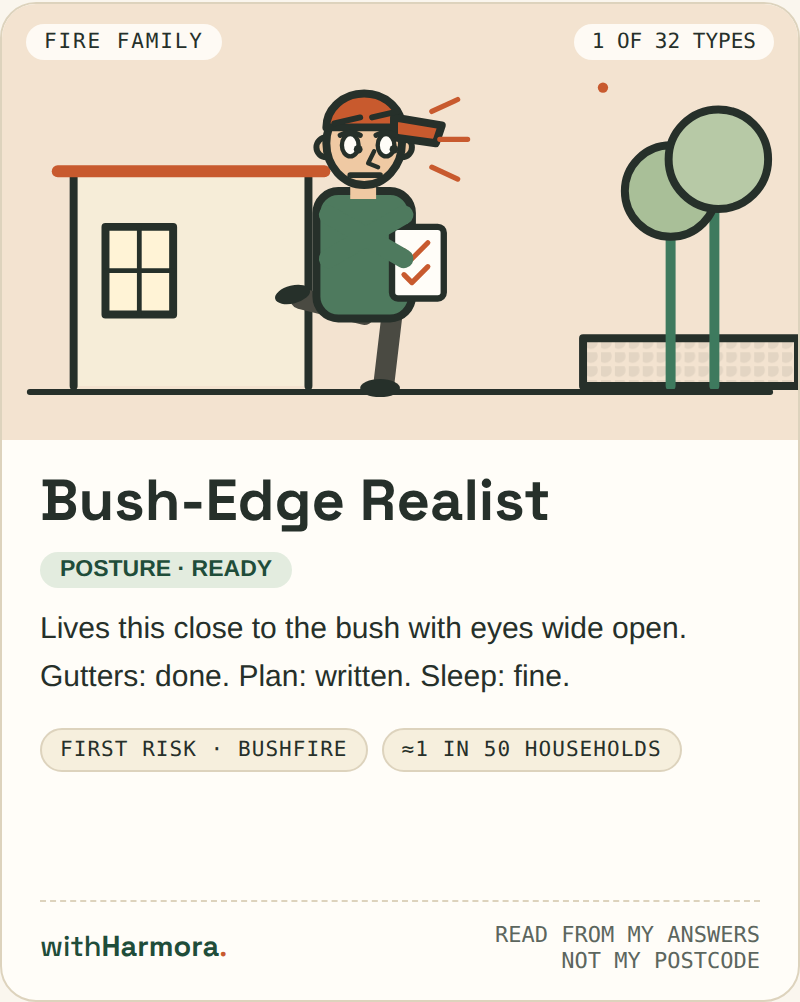
Computed for the sample household · Tue 27 October 2026
Basis: withHarmora engine v2 — the 91-risk register · NSW Bush Fire Prone Land mapping (NSW RFS) · SILO gridded climate data 2005–2024 (Queensland Government, from Bureau of Meteorology observations) · NPWS Fire History (CC BY 4.0) · your answers to the household check.
Your household, in four dimensions
Four dimensions, one season running through them
Not one hazard at a time — the whole household, on four axes. This is the Spring 2026 picture: the season is the time axis through all four, not a separate chapter.
LAND — exposure
28 of 100 · Moderate
What the place itself sends at the house.
Average of 19 scored items in this dimension, from this household's own register.
HOUSE — vulnerability
28 of 100 · Moderate
What the building and its fabric add.
Average of 17 scored items in this dimension, from this household's own register.
PEOPLE — fragility
31 of 100 · Moderate
What the people in the house ask of every plan.
Average of 14 scored items in this dimension, from this household's own register.
READINESS — posture
70 of 100 · Ready
What the household already has ready.
The readiness index from the 12 readiness answers — not an average of gap or capability indices.
Inside the dimensions
What each dimension is made of, for this household
LAND — exposure
- Bushfire (incl. grassfire) — 98 of 100 · bush-edge-touching — because you said bushland touches your fence.
- Lightning — 42 of 100 · no-rcd — because you are not sure safety switches are fitted.
- Severe cold / frost — 36 of 100 · seniors-present — because older household members feel cold sooner.
HOUSE — vulnerability
- Smoke haze / poor air quality — 44 of 100 · near-bushland — because smoke sources sit close to your home.
- Epidemic / pandemic disruption — 42 of 100 · vulnerable-members — because household members are in higher-risk groups.
- Dangerous animals (snakes / spiders) — 42 of 100 · bush-edge — because bushland touches your fence — snakes and spiders come with it.
PEOPLE — fragility
- Falls (seniors, stairs, bathrooms) — 78 of 100 · seniors-present — because older members live at home.
- Electric shock / ageing wiring — 50 of 100 · no-rcd — because safety switches not confirmed.
- Medication mismanagement — 38 of 100 · seniors-on-medication — because older members managing medication.
PEOPLE — who lives here
- Someone aged 65 or over lives here.
- Children under 13 live here.
- Someone takes regular medication.
- Some medication needs refrigeration.
READINESS — the 12 readiness answers
- Written emergency plan: yes.
- Go-bag: packed and ready.
- Drinking water stored: about 4 days.
- Food on hand: about 5 days.
- Documents backed up outside the house.
- Signed up to state emergency alerts.
The twist
The dimension that argues loudest
Your type is The Bush-Edge Realist, and the PEOPLE dimension is where this household scores highest.
PEOPLE — Falls (seniors, stairs, bathrooms) (78 of 100)
Falls (seniors, stairs, bathrooms) is a first-order concern for your household — driven first by seniors-present: older members live at home.
Where dimensions meet
Risks you only see when dimensions combine
Each pair below names the two dimensions and the top scored item in each — the combination is shown, not asserted beyond what the register scores.
LAND × PEOPLE — Bushfire (incl. grassfire) × Falls (seniors, stairs, bathrooms)
Bushfire (incl. grassfire) is a first-order concern for your household — driven first by bush-edge-touching: you said bushland touches your fence. Falls (seniors, stairs, bathrooms) is a first-order concern for your household — driven first by seniors-present: older members live at home.
HOUSE × READINESS — Smoke haze / poor air quality × readiness 70 of 100
Smoke haze / poor air quality is worth planning for at your household — driven first by near-bushland: smoke sources sit close to your home. The largest open reserve gap is Drinking-water reserve — Covered at the benchmark level.
PEOPLE × Spring 2026 — Falls (seniors, stairs, bathrooms) in this season
Falls (seniors, stairs, bathrooms) is a first-order concern for your household — driven first by seniors-present: older members live at home. The season runs through this dimension like the others: the same household reads differently as the season turns, and each new edition re-reads it.
The same four dimensions, in four scenes
Leaving, at home, money, neighbours
Leaving
- School pickup & family meeting plan — Pickup plan not worked out yet.
- Caravan / camping self-shelter capability — No caravan/camping self-shelter reported — lodging depends on others.
- Friends / family to stay with — Not answered yet.
At home
- Smoke haze / poor air quality — 44 of 100
- Epidemic / pandemic disruption — 42 of 100
- Dangerous animals (snakes / spiders) — 42 of 100
Money & effort
Best return on effort in Stage 1, by the engine's own ranking of risk removed per dollar: Write your household emergency plan — Decide together: when you would leave and when you would stay, where you would go, a meeting point if separated, and how you will follow official warnings. ($0, 45 minutes).
Neighbours
- Friends / family to stay with — Not answered yet.
- School pickup & family meeting plan — Pickup plan not worked out yet.
- Knowing where evacuation centres get announced — Evacuation centres are announced during events by councils/SES; this line records where to look, and is not scored.
- Potential shelter facilities nearby (schools / halls) — Nearby facilities with shelter potential are a point-data reconnaissance item; presence never means official designation.
Evidence
Hazards as evidence, not chapters
The ten highest scored risks, each tagged to the dimension it evidences. Every line shows both sources: the external data on one side, your own answers on the other.
1 · Bushfire (incl. grassfire)
LAND98 / 100Made of: official mapping for your postcode × you said bushland touches your fence; 17 fire seasons are recorded in this postcode.
2 · Falls (seniors, stairs, bathrooms)
PEOPLE78 / 100Made of: national baseline for Australian homes × older members live at home; no grab rails or non-slip in the bathroom; stairs inside or at the entry.
3 · Electric shock / ageing wiring
PEOPLE50 / 100Made of: national baseline for Australian homes × safety switches not confirmed.
4 · Smoke haze / poor air quality
HOUSE44 / 100Made of: published official guidance × smoke sources sit close to your home.
5 · Lightning
LAND42 / 100Made of: published official guidance × you are not sure safety switches are fitted.
6 · Epidemic / pandemic disruption
HOUSE42 / 100Made of: published official guidance × household members are in higher-risk groups.
7 · Dangerous animals (snakes / spiders)
HOUSE42 / 100Made of: published official guidance × bushland touches your fence — snakes and spiders come with it.
8 · UV exposure
HOUSE38 / 100Made of: published official guidance × no household answer moved this item — postcode-level reading.
9 · Medication mismanagement
PEOPLE38 / 100Made of: national baseline for Australian homes × older members managing medication.
10 · Severe cold / frost
LAND36 / 100Made of: published official guidance × older household members feel cold sooner.
Action · Stage 1
Things you can do today
Stage 1 tasks from the household's own path, in the engine's order. The engine ranks steps but does not compute a before-and-after dimension score for a single step, so no such number is claimed here: each step is described by what it targets, in the engine's own words.
1 · Write your household emergency plan
Decide together: when you would leave and when you would stay, where you would go, a meeting point if separated, and how you will follow official warnings.
Why this step: Most harm in a bushfire event comes from decisions made under pressure — a short written plan means your household already knows when to leave, where to go, and what to follow. (Australian Red Cross — RediPlan (PDF))
Find it at Kmart Affiliate link
2 · Store drinking water for three days
Store at least 10 litres of drinking water per person — enough for three days if taps stop or water is unsafe.
Why this step: If bushfire interrupts your water supply, this gives everyone at home three days of drinking water without depending on shops or working taps. (Queensland Government — Pack an emergency kit)
Find it at Bunnings Affiliate link
3 · Pack a first aid kit and your regular medications
A household first aid kit, plus at least three days of each person's regular prescription medication kept with the kit, and spare glasses if you wear them.
Why this step: If bushfire closes roads or pharmacies for a few days, having your regular medication and a first aid kit at home covers the gap without a trip out. (Queensland Government — Pack an emergency kit)
Find it at Chemist Warehouse Affiliate link
4 · Set up light and emergency information
A torch for each person, spare batteries, a battery or wind-up radio set to your local ABC frequency, and a charged power bank for phones.
Why this step: When the power and mobile networks go down during bushfire, a torch and a battery radio are how your household still gets light and official warnings. (Queensland Government — Pack an emergency kit)
Find it at Bunnings Affiliate link
5 · Secure your documents and emergency cash
Copy your ID, insurance, Medicare and property documents to a USB and cloud storage, keep a printed set in a waterproof pouch, and hold spare cash in small notes.
Why this step: If you have to leave home quickly because of bushfire, having your documents and cash ready means proving who you are and paying for essentials never depends on going back. (Queensland Government — Pack an emergency kit)
6 · Stock three days of no-cook food
Keep three days of long-life food your household actually eats, plus a manual can opener — nothing that needs refrigeration or cooking.
Why this step: With power out and shops closed or unreachable, three days of ready-to-eat food means bushfire doesn't turn into a food problem on day one. (Queensland Government — Pack an emergency kit)
Find it at Woolworths Affiliate link
7 · Get your pets ready to stay or go
Three days of pet food and water, a carrier or lead, your vet's details, and a recent photo of each pet — stored with the household kit.
Why this step: If bushfire means leaving in a hurry, having your pet's food, carrier and vet details already packed means they leave safely with you — no trip back. (Queensland Government — Pack an emergency kit)
Links marked “Find it” are affiliate links: if you buy through one, withHarmora may earn a commission at no extra cost to you. Commissions never change which steps we recommend or the order they appear in — that order is set only by your household's risks and gaps.
Where this sample ends
Every number above belongs to the sample household — yours is still unwritten
This household sits at the edge of the bush in Katoomba and answered the way it did. Your report is the same book, rebuilt from your own ground: the sections where this household is quiet could be the loudest in yours, and the ones where it scores high could drop away entirely. Nothing here is a preview of your numbers — only of the care taken to earn them.
withHarmora is an independent information service, not an emergency service, and does not replace official warnings. In an emergency, call 000 — and follow your state fire or emergency service and the Bureau of Meteorology. Terms · Method & sources